About
The story behind POC Prison (and why this matters)
The Escape POC Prison framework started with a simple observation. Almost every organization investing in AI runs into the same pattern. There are plenty of ideas, demos, and pilot projects; but very little actually reaches production.
That pattern is remarkably consistent. Teams build prototypes and leadership sees the potential. But there is no clear path to turn those prototypes into systems that run in the business. No paved road. No operational setup. No clear ownership. So the promising prototype turns into an AI zombie - kinda dead, but still walking around.
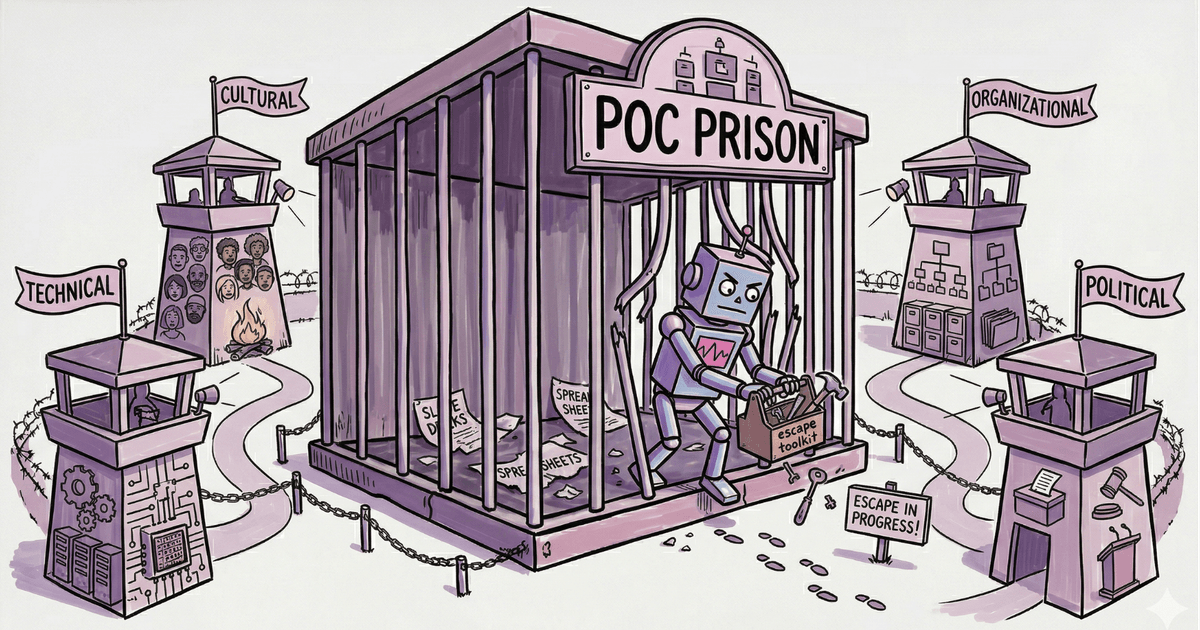
This is not just a technology problem; but it is not purely organizational either. The models work. But integration is hard. Connecting AI to real systems, real data, and real workflows is messy, time-consuming, and often underestimated.
So most organizations stay in a safe space. A chat-like interface. Copy, paste, rinse, repeat. It looks useful; but it is not integrated, not automated, and not operational. The result is low value.
What is missing is the ability to move beyond that stage; to integrate, operate, and take responsibility for AI in production.
The Mission
Escape POC Prison framework exists to help organizations break out of that pattern. Through the book, the toolkit, and the 90-day program, it provides a structured way to move from experimentation to production. The goal is not to deliver a single use case. The goal is to build the capability to integrate, operate, and scale AI as part of everyday work.
The Approach
The approach is practical, opinionated, and grounded in real experience. It is built on these principles:
- POC prison is an operating model problem, not a tooling problem.
- Organizations escape by building delivery capability, not by launching more POCs.
- The 90-day model works because it forces focus, creates accountability, and delivers visible results before momentum fades.
- Key concepts: tiger team, paved road, lighthouse use cases, governance, and moving from experimentation to execution.
- No buzzwords. No transformation theatre. Just practical work that gets things into production.
About Luise
Luise is an Azure & Power Platform Architect based in Germany and a Microsoft Most Valuable Professional (MVP). She works with organizations that want to move beyond digital theatre and turn AI from experimentation into real, operational systems.
Her focus is on operationalizing AI in enterprise environments; aligning technology, governance, and organizational structures so solutions don't just work once, but continue to work in production. She helps teams design accessible apps, build robust data models, and implement automation that respects compliance, ownership, and human effort. The Escape POC Prison framework captures this experience as a structured, practical approach to moving from proof of concept to production.
A recurring theme in her work is making the invisible visible: unmeasured work, emotional load, operational friction, and the real cost behind "quick wins". She is known for combining deep technical understanding with a sharp eye for organizational patterns; and for asking the uncomfortable questions that often reveal why initiatives fail long before technology becomes the problem.
Alongside client work, Luise writes and speaks about productivity myths, pseudo-agile practices, AI readiness, and the structural reasons organizations get stuck in pilot phases. Her work is grounded in real delivery experience, not theory.
Her motto, "Changing the world one app at a time", comes from her extensive work with non-profit organizations.
Outside of work, she is a runner, a mother of (teenage) dragons, a LEGO builder, and a fan of the number 42. Her favorite color is #ff69b4.
Want to escape POC prison?
Start with the book, explore the toolkit, or talk to us about your organization's situation.