From AI prototype to production
Your teams can build AI.
They just can't ship it.
Why teams don't ship
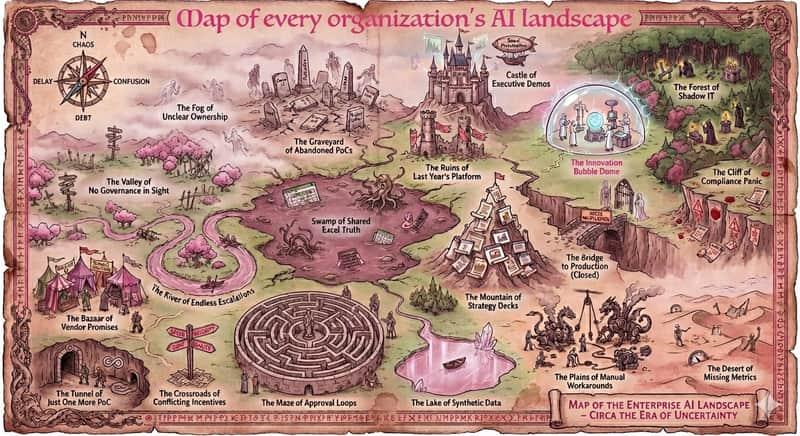
POC prison is what happens when teams can build prototypes, but the organization cannot help them ship.
The prototypes work. The demos impress. But nothing ever reaches production because the delivery infrastructure, governance, and ownership are missing.
If your organization has more than three AI proofs of concept and fewer than three in production, you are probably in POC prison.
Have a look at the map and see if some of the landmarks feel familiar to you.
This is not a technology failure. It is a delivery failure.
Why this matters
Every initiative that does not reach production represents wasted budget, wasted team capacity, and wasted opportunity. But the cost goes further than that.
Unmanaged risk
Pilots quietly become dependencies without governance, monitoring, or ownership. When something breaks, leadership owns the fallout.
Costs you: reputation, compliance exposure, executive credibility.
No repeatability
Every new initiative starts from scratch. No shared patterns, no reusable infrastructure, no institutional knowledge.
Costs you: time, money, team capacity, delivery speed.
Growing skepticism
Stakeholders see activity but no measurable results. Confidence in AI as a strategic lever erodes with every quarterly review.
Costs you: executive trust, future funding, organizational momentum.
Governance exposure
Uncontrolled systems create compliance, security, and audit risks. When regulators ask questions, there are no good answers.
Costs you: legal risk, audit findings, regulatory penalties.
Talent drain
Good people do not stay where their work never ships. Permanent pilot mode signals that execution does not matter here.
Costs you: morale, retention, hiring competitiveness.
Sunk investment
Every pilot consumed budget, vendor time, and team effort. When it does not reach production, that investment returns nothing.
Costs you: direct spend, opportunity cost, competitive position.
Are we actually getting value from AI?
For executives, transformation leads, and decision-makers responsible for AI investment outcomes.
16 questions across four areas: Strategy & Prioritization, Ownership & Delivery, Organizational Readiness, and Governance & Culture.
Answer based on how things actually work today, not how they should. Takes about 5 minutes.
This runs entirely in your browser. Nothing is collected, stored, or sent anywhere.
The 90-day escape path
A structured program that builds real delivery capability, not another strategy document.
Make reality visible
Assess where you actually are. Run the portfolio diagnostic to separate real progress from activity. Identify who owns what. Build the foundation so that production becomes the default path.
Build the delivery path
Select one or two use cases with the right combination of business value and delivery feasibility. Apply the production readiness scorecard. Move from prototype to a production-ready system.
Ship, stabilize, and standardize
Ship the system into production with monitoring, governance, and accountability in place. Document the delivery path so every future initiative follows the same route.
The book - coming soon
From AI Prototype to Production
A Practical Playbook for Escaping POC Prison in 90 Days
The book explains why organizations get stuck: the structural, political, cultural, and operational patterns that keep AI initiatives from reaching production. It gives you the language to diagnose the problem and the clarity to see what needs to change.
The toolkit and guided programs help teams overcome those blockers: structured execution, governance, readiness scorecards, and operational templates to actually ship.
Book
From AI Prototype to Production
The 90-Day Escape Path

About Luise
Luise is an Azure & Power Platform Architect based in Germany and a Microsoft Most Valuable Professional (MVP). She works with organizations that want to move beyond digital theatre and turn AI from experimentation into real, operational systems.
Her focus is on operationalizing AI in enterprise environments: aligning technology, governance, and organizational structures so solutions don't just work once, but continue to work in production.
A recurring theme in her work is making the invisible visible: unmeasured work, emotional load, operational friction, and the real cost behind "quick wins". She combines deep technical understanding with a sharp eye for organizational patterns, and asks the uncomfortable questions that often reveal why initiatives fail long before technology becomes the problem.
Her motto: "Changing the world one app at a time."
Ready to help your teams actually ship?
If your teams can build but keep getting stuck before production, this is the system that fixes it.